A fractional CFO gives your business chief financial officer-level leadership for part of the week, without the commitment of a full-time hire. If the numbers are growing faster than your ability to stay on top of them, that gap won't close on its own.
Most founders we speak to don't need a CFO five days a week. They need one at the moments that matter: the raise, the board pack, the meetings where the numbers have to be right.
What does fractional CFO mean?
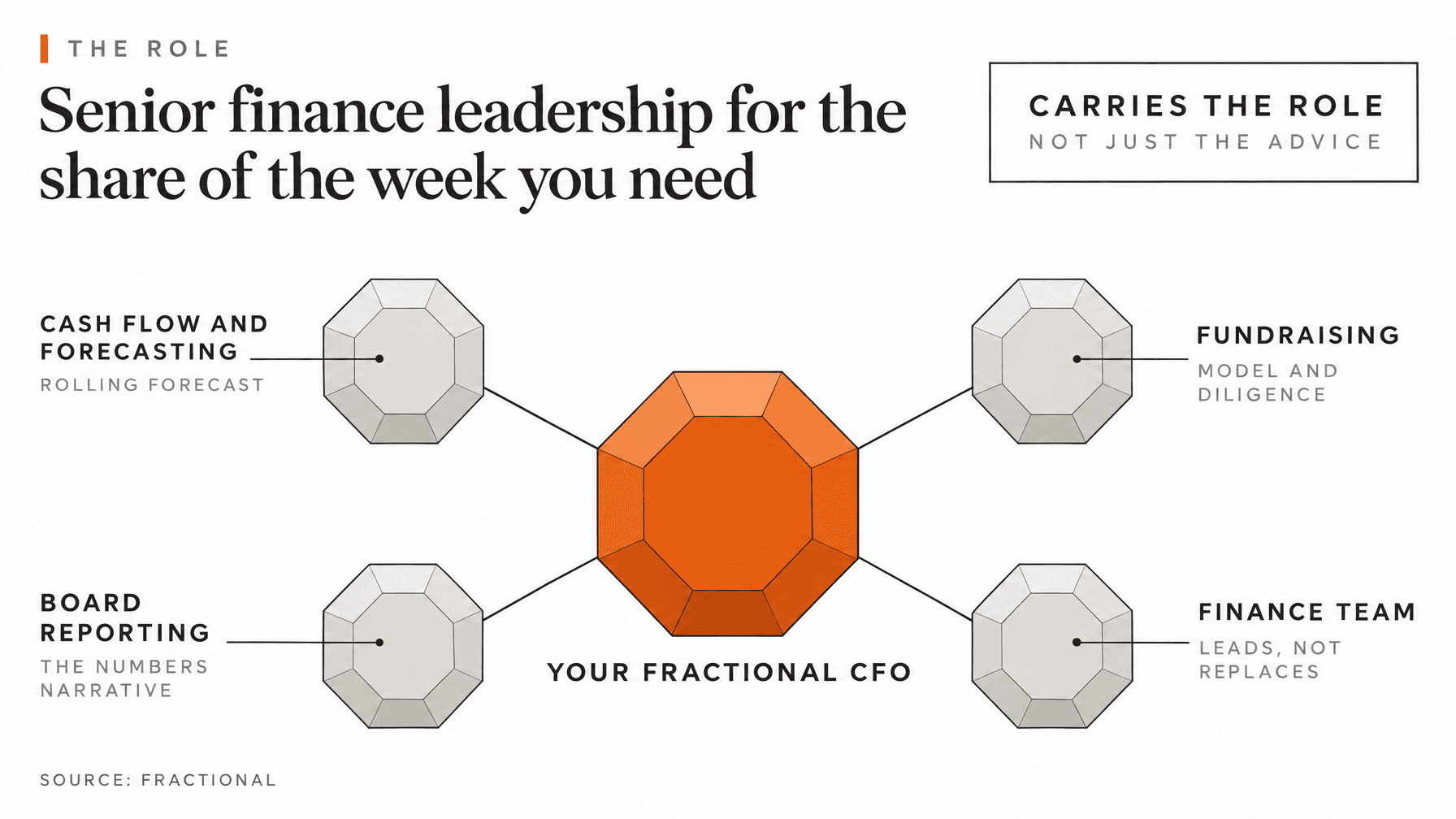
A fractional CFO is an experienced chief financial officer who embeds in your business on a part-time basis, without the commitment of a full-time hire. They advise, execute and stay accountable to outcomes: cash flow, forecasting, board reporting, fundraising and leading the finance team. You get CFO-level judgement for the share of the week you actually need.
The "fractional" part is about time, not seniority. This is a CFO, with the scar tissue the title implies, working an agreed number of days each month. The rest of the week, they typically do the same for a small number of other businesses.
A good fractional CFO works a bit like a leading barrister. Senior judgement on tap when it matters, without a permanent place on the payroll.
You'll also hear part-time CFO, outsourced CFO and portfolio CFO. In practice, they describe the same shape of engagement. What matters is what's written down: scope, deliverables, meeting rhythm and decision authority, agreed before the work starts [1].
Engagements are usually shaped in one of two ways. Some run as an ongoing monthly commitment covering an agreed set of days. Others are built around a defined piece of work, like a raise or a system change. Either way, a fractional CFO is more embedded than an outside adviser. They join your leadership meetings, own the finance agenda and answer for it.
According to Axios, the number of LinkedIn profiles with "fractional" in the title rose from around 2,000 in 2022 to more than 142,000 by early 2025.
What a fractional CFO does day to day
The short version: they run finance as a function, not a filing exercise. The detail depends on your stage, but the core responsibilities are consistent: cash flow, forecasting, budgets, management reporting, fundraising, board reporting and finance-team leadership [1]. The common thread is ownership. Each area has a senior name attached to it, and that name answers at board level.
Cash flow and forecasting
Cash is usually why founders call. A fractional CFO builds the rolling forecast, keeps it honest and tells you what's coming before it arrives. Budgets, management accounts and cash planning all sit here.
Board and investor reporting
They produce the board pack, the numbers narrative and the answers to the hard questions. If investors are involved, they manage that reporting rhythm and the relationship around it.
Fundraising and growth
When you raise, they build the model, prepare you for diligence and sit beside you in the meetings. When you grow, they make sure the finances keep up with the plan.
Leading the finance team
A fractional CFO directs your bookkeeper, financial controller or accountant, sets the standards and lifts the quality of everything the team produces. They don't replace the day-to-day transactional work. They lead it.
SaaS businesses
Fractional CFO roles shift with the business model. A SaaS fractional CFO works to recurring revenue: MRR and ARR, churn, burn and runway, priced and reported the way software investors expect. The mechanics differ from an invoiced-sales business, and so do the questions investors ask.
What is the difference between a fractional CFO and a consultant?
A consultant advises on a defined problem, delivers recommendations and moves on. A fractional CFO takes ongoing responsibility for your finance function. They own forecasting, reporting and cash, sit in leadership meetings and act as your senior finance decision maker. One gives advice. The other carries the role.
The difference is responsibility over time. A consultant's engagement ends when the project ends. A fractional CFO's engagement continues, month after month, through board cycles and budget rounds.
Fractional CFO | Consultant |
|---|---|
Works part-time as your senior finance leader | Hired to advise on a defined problem or project |
Owns recurring work: forecasting, reporting, cash | Delivers recommendations, analysis or implementation support |
Sits in leadership and board meetings | Shorter, project-based engagement |
Accountable for execution as well as advice | Accountability usually ends at the recommendation |
The line blurs in practice, which is why the written terms matter. They should say who owns execution, how much time is committed and what happens when the advice needs implementing.
Fractional CFO vs an accountancy-led finance director
Your accountant looks backwards, by design: statutory accounts, tax, compliance, what happened last year. A fractional CFO looks forwards: what cash you'll need, what the plan costs, which growth you can afford. Both matter. They're different jobs, and a good fractional CFO makes your accountant more effective, not redundant.
Fractional CFO vs a full-time CFO
A full-time CFO makes sense when the finance workload genuinely fills five senior days a week, usually in a larger, more complex business. Before that point, you're paying for a chair to be filled. A fractional CFO gives you the same seniority in the dose the business actually needs, and the cost gap is significant. The numbers are below.
When to hire a fractional CFO
Most businesses don't hire a fractional CFO on a schedule. They hire one when something specific happens. The triggers we see most often:
- You're raising. Investors want a model that survives diligence and a founder who knows their numbers cold.
- Cash keeps surprising you. The pain is rarely the balance itself. It's the surprise.
- Growth has outpaced the books. Revenue doubled; the finance function didn't.
- You need cover. Maternity leave, a sabbatical or a sudden gap in a senior finance seat.
- You're preparing for exit. Buyers pay for clean numbers and a credible finance story.
- You're turning the business around. Someone senior needs to own the plan and its numbers.
Just as important is when not to. If the problem is transactional, like bookkeeping, payroll or VAT, you need an accountant or financial controller first. A fractional CFO is senior leadership, not an expensive pair of hands.
Founders usually call later than they should. The raise is three weeks away, the board pack is due, the gap is already showing. Earlier is cheaper and calmer.
If several of these sound familiar, our fractional CFO readiness assessment will help you work out whether the timing is right.
Timing matters. The last few years taught every founder how fast conditions can move: rates, costs, hiring, demand. Finance tooling is shifting quickly as well, and navigating change takes experienced leadership, not just new software.
How much does a CFO make at a mid-sized UK company?
No reliable UK salary figure is tied to turnover alone. Sector, ownership, profitability and group complexity all move the number. As a benchmark, the Robert Walters UK Salary Survey 2026 reports an average CFO base salary of £268,340 [2].
Two businesses at the same turnover can need very different CFOs. A private equity-backed group with acquisitions planned is a different job from a founder-led company with steady margins. Price the role against comparable live vacancies and current salary surveys, not against turnover.
Role | Reported average base salary |
|---|---|
Chief financial officer | £268,340 |
Finance director | £195,673 |
Head of finance | £168,975 |
All figures from the Robert Walters UK Salary Survey 2026 [2]. These are national survey figures rather than turnover bands, so treat them as a starting point.
Salary is also not the whole cost. Employer Class 1 National Insurance is due on earnings above the £5,000 secondary threshold in the 2026-27 tax year [3][4]. Pension contributions, bonus, benefits and recruitment fees sit on top, though some smaller employers offset part of the NICs bill through the Employment Allowance. When you compare a hire against a fractional engagement, compare total employment cost, not the salary line.
How much does a fractional CFO cost in London?
There is no standard London price, because cost follows scope rather than postcode. Most engagements run as a monthly retainer covering an agreed set of days, or as a day rate for defined pieces of work. As a marker, UK provider guidance cites specialist fractional CFO day rates of £1,800 or more [1]. What you pay in practice depends on how many days a month you need, at what seniority, solving which problems.
Each pricing shape suits a different situation. Retainers suit ongoing leadership, where the CFO owns the finance rhythm month after month. Day rates suit bursts: a raise, a system change, a diligence process. Fees, expenses and what's included should all be in writing before the work starts.
What moves the quote: days per month, the seniority you need, sector complexity, whether investors are involved, and how much of the finance team the CFO is carrying.
Before you sign, ask for an itemised quote. It should show the included days or hours, how expenses and travel are handled, whether VAT is included, any minimum term and the notice period. Ask whether implementation work, bookkeeping or software sits inside the fee or outside it. Two quotes that look similar can cover very different scopes.
Set against the full-time alternative:
| Full-time CFO | Fractional CFO |
|---|---|---|
Base cost | Reported average base salary of £268,340 a year [2] | Day rate or monthly retainer, scoped to agreed days |
Employer NICs | Due on earnings above the £5,000 secondary threshold [3][4] | Not on your payroll; tax treatment depends on how the engagement is structured |
Pension, bonus, benefits | On top of salary | Not applicable |
Commitment | Permanent hire, notice to exit | Agreed days, defined notice |
Best fit | Large, complex, daily CFO workload | Growing businesses needing senior input some of the time |
The real comparison is total annual employment cost against the senior days you actually need.
Tax treatment depends on how the engagement is structured, so take advice on IR35 where it's relevant.
A word on price: pay for stage-appropriate experience and evidence of outcomes, not the lowest day rate.
Can a fractional CFO work with a London business remotely?
Yes. A fractional CFO can work on a remote or hybrid basis: video calls, shared dashboards and secure access to your accounting, payroll and banking systems, with on-site days when the board or investors need them [5][1]. Geography rarely decides quality. Structure does.
Remote works when the engagement is set up properly. That means secure system access, a fixed meeting rhythm, clear authority over payments and reporting, agreed response times and proper confidentiality and data-security arrangements. Occasional days in London, for board meetings or investor sessions, are easy to schedule around that. Remote delivery can also take travel time out of the engagement, but don't assume it lowers the fee. Any travel or attendance charges belong in the written terms.
So if you're searching for a "fractional CFO near me", widen the lens. Postcode is the wrong question. Ask whether the person has done your stage, in your sector, with references to prove it. The right CFO on video beats the wrong one in the next borough.
How can I become a fractional CFO?
Most fractional CFOs spend years in senior finance roles first: finance director, financial controller, head of finance or CFO. From there, they build commercial skills beyond accounting and choose the stages and sectors they know best. They define a clear offer, then agree written terms on scope, availability and authority with each client.
There's no single mandated UK route. Qualifications such as ACA, ACCA or CIMA help with credibility, but what clients buy is evidence: raises completed, cash managed, teams led, boards handled.
The practical steps look like this:
- Build senior experience in roles like finance director, financial controller or head of finance.
- Add commercial skills: modelling, fundraising, board reporting, strategic planning.
- Specialise in the stages and sectors you know best.
- Define a clear offer, such as monthly forecasting, board packs or cash management.
- Decide whether to work independently, through a fractional firm or as a portfolio executive.
- Put written terms in place: scope, availability, fees, confidentiality, conflicts, authority and liability.
If you're reading this as a founder, that list doubles as a vetting checklist. The strongest fractional CFOs tick every line.
How to choose a fractional CFO
Judge any firm or individual on the same criteria:
- Real CFO-level experience. Not just accountancy: someone who has sat in the seat at your stage.
- Stage and sector fit. A CFO who has raised at your size, in your sector, will outrun a more senior CV from the wrong world.
- Vetting depth. Who screened this person, and how? Ask for the process, not the adjectives.
- What happens after the introduction. Is there support, structure and governance around the engagement, or are you on your own once it starts?
- References you can actually call.
- Terms. Time commitment, notice and exit, in writing.
Watch for the red flags too: vague scope, no named references, and anyone who leads with price before they ask about your business.
Fractional works to the same criteria. Our collective of 1,000+ curated executives is not open: each is screened before they join. We match a CFO to your stage, sector and challenge. Your CFO owns the outcomes. Around them, we provide the support, structure and governance, so you're never managing a senior hire alone. Embedded, not placed and left.
Behind each executive sits the wider collective, so a second pair of senior eyes is always within reach.
See how we work with SMEs, or read more about our fractional CFO services.
You're already making CFO-level decisions. The question is how long you keep making them without a CFO.
Talk to us about hiring a fractional CFO
Sources
[1] FD Capital, Fractional CFO: https://www.fdcapital.co.uk/fractional-cfo/
[2] Robert Walters, UK Salary Survey 2026: https://www.robertwalters.co.uk/content/dam/robert-walters-redesign/country/united-kingdom/files/salary-survey/UK-Robert-Walters-Salary-Survey.pdf
[3] GOV.UK, Rates and thresholds for employers 2026 to 2027: https://www.gov.uk/guidance/rates-and-thresholds-for-employers-2026-to-2027
[4] GOV.UK, Rates and allowances: National Insurance contributions: https://www.gov.uk/government/publications/rates-and-allowances-national-insurance-contributions/rates-and-allowances-national-insurance-contributions
[5] Scale With CFO, Fractional CFO London: https://www.scalewithcfo.com/fractional-cfo-london