A retained search typically costs about a third of the hire's first-year cash compensation, payable whether or not the role is filled [1][2]. Most firms won't tell you that until the proposal lands. Type "executive search firms London" into Google and you'll get polished pages, a few listicles and almost no prices.
If you're a founder weighing up a senior hire, that silence is the problem. You can't compare what you can't see.
We run Fractional, so we're not neutral here. The fee figures below come from SEC filings and published terms of business. Not from us.
How much does an executive search cost in the UK?
There's no published tariff. The convention, set out in Korn Ferry's SEC filings, is a fee of about a third of the successful candidate's first-year cash compensation, charged whether or not the role is filled [1][2]. UK agency guides quote indicative ranges in that territory, applied to first-year compensation [3][4][5]. The engagement letter sets the actual figure.
Executive search fees: do the arithmetic before you sign
Start with the arithmetic, because it's the part most firms skip. Take the first-year compensation for your role and apply the percentage in the proposal. Then add VAT, expenses and any separately agreed costs, which headline quotes typically exclude [3][4]. The result is the number to compare proposals on, not the headline rate.
Firms rarely publish tariffs, so treat any figure as provisional until it's in your engagement letter [5].
The base matters as much as the percentage
Some firms charge on base salary. Others charge on total cash, which pulls bonus into the fee. Korn Ferry's wording is first-year annual cash compensation, not base salary alone [1]. Two proposals quoting the same percentage can differ materially depending on the base.
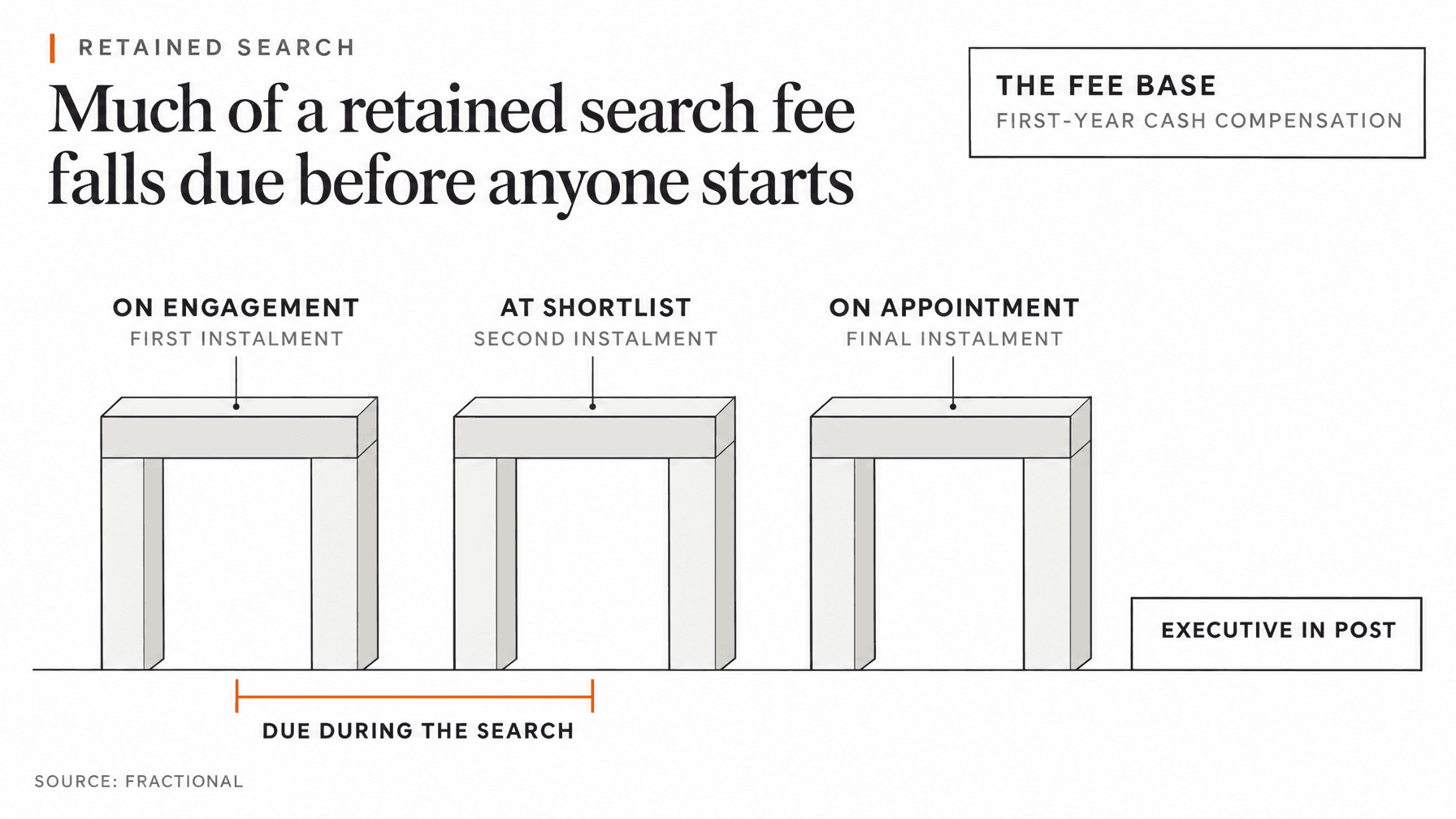
And the money doesn't all land after the hire. Under the usual instalment structure, the first and second instalments fall due during the search, before anyone starts [3][6].
What percentage fee do retained search firms charge?
Korn Ferry's SEC filings say retained firms typically charge approximately one-third of a role's first-year annual cash compensation [1][2]. UK agency guides describe the same convention, commonly quoting around a third of first-year compensation [3][4][5]. There's no settled single percentage: firms differ on whether the base is salary alone or total cash, so compare proposals on the same basis.
The clearest public reference point exists because Korn Ferry, a major global search firm, files publicly with the SEC. Its FY2020 and FY2021 filings both state that retained firms typically charge about a third of the position's first-year annual cash compensation, whether or not the position is filled [1][2].
When someone asks "how much do executive search firms charge", the honest answer is: a percentage of first-year compensation, plus whatever the engagement letter adds. Assessment, market mapping, referencing and travel can all be billed on top [5].
How the instalments usually work
UK agencies commonly split the fee into three instalments: on engagement, at shortlist or an agreed midpoint, and on appointment or start [3][4]. Two published examples show the mechanics. Younion's terms of business set separate search and shortlist fees, then a success fee bringing the total to 33% of remuneration if a candidate is engaged [7]. Reed's executive search terms describe a retainer of one-third of the calculated fee, invoiced before services commence [8].
Different structures. Same direction of travel. A meaningful share of the money moves before anyone joins you.
Notice the shape of that. You can pay most of the fee and still have no executive in post. It's a bit like a house purchase that falls through after the survey and the searches: everyone did their job, and you still don't have the house.
Because no regulator sets the tariff, the engagement letter is the whole game. It determines the fee base, instalment dates, expenses, the guarantee or rebate if the hire leaves, exclusivity and off-limits provisions [4]. Read it before the search starts. Not after the second invoice.
What is the top executive search firm in the UK?
There's no single top firm for every brief. The right choice depends on your sector, the seniority of the role, how confidential the search is and who actually does the work. Judge any firm on vetting depth, accountability for the outcome, time to start, exit terms, local market knowledge and how the fee is charged.
How to choose an executive search firm in the UK
These criteria hold whether you're comparing executive search firms UK wide or choosing between London specialists. Ask each one:
- Vetting depth. How are candidates assessed and referenced, and by whom?
- Accountability for the outcome. What happens if the hire leaves within months? Is there a replacement guarantee or rebate?
- Time to start. When does work begin, and when will you see first candidates?
- Notice and exit terms. What have you paid if you pause or cancel mid-search?
- Local market knowledge. Can they name the companies and candidate markets they'll approach, in writing?
- Fee structure. What's the base, when do instalments fall due, and what's charged on top?
A firm that won't put those answers in writing has told you something.
How Fractional meets those criteria
Every executive in our collective of 1,000+ is curated before they're matched to a brief. We don't introduce and step away. Every engagement carries support, structure and governance from our team, and the executive is accountable to outcomes.
Engagements run on rolling terms with one month's notice. And we match on stage, sector and challenge, built specifically for SMEs.
Who are the biggest executive search firms?
The names most often cited as major global executive search firms are Korn Ferry, Spencer Stuart, Russell Reynolds Associates, Heidrick & Struggles and Egon Zehnder. No comparable UK revenue ranking is published, so treat them as prominent rather than ranked. Alongside them sit UK-headquartered and specialist boutiques, many covered by Recruiter, the industry trade title [9][10].
Global scale matters for some briefs: a listed-board succession, a confidential appointment, a hire across several countries. It matters less for a growing business hiring its first finance chief. Recruiter maintains dedicated executive-search coverage and reports regularly on London-headquartered firms and their appointments [9][10]. Biggest and best for your brief are different questions.
Is executive search well paid?
It can be, but pay varies sharply by seniority, firm, sector and commission plan. Consultants are typically paid a basic salary plus commission linked to the fees they bill, so earnings swing with performance. There's no verified UK-wide average; advertised packages range widely, and senior partners on retained work can earn substantially more.
Why should a buyer care what search consultants earn? Because commission shapes behaviour. The person pitching your search is usually paid on billed fees, and instalments count as billings. That structure rewards starting searches.
Good firms manage it. Even so, ask who will run your search day to day, and how senior that person is. Ask what happens to their attention once your second instalment clears. Fair questions. A serious firm will answer them.
Be wary of anyone quoting you a definitive industry average for consultant pay. The evidence for one doesn't exist publicly.
Are executive search firms worth it?
Yes, when the appointment is strategically important, confidential, hard to fill or aimed at candidates who are not actively applying. A retained search buys proactive outreach, market mapping, assessment and a committed process. It's harder to justify when the candidate market is deep and accessible, or when the search is run like ordinary contingency recruitment [5].
The fee tends to earn its keep when:
- The role is board-level and the hire has to be right first time
- The search is confidential and can't be advertised
- The candidates you want aren't applying anywhere
- You lack the internal capacity to map and approach the market
It's harder to justify when the candidate market is deep and reachable, or when your own team could source it. The same goes when the firm can't show real sector access, or you're paying for a brand name while junior staff run the work [5].
If you proceed, ask for a written proposal covering the fee, the base, the stages, who does the work and the guarantee. For most SMEs, though, the sharper question is whether you need a permanent hire at all. If the need is cover, a first Chief Financial Officer, a turnaround or a defined project, you're buying leadership, not a recruitment process. Non executive director recruitment sits in the same territory: a board-level need that doesn't always justify a full retained process.
The fractional alternative: executive search, done fractionally
A fractional executive is a C-suite or director-level professional who embeds directly into your business without the commitment of a full-time hire. They advise, execute and are accountable to outcomes.
Founders come to us in recognisable situations. A first fractional Chief Financial Officer after a funding round. A fractional Chief Operating Officer to professionalise delivery. Maternity cover at finance-director level. A turnaround that can't wait out a search.
According to Axios, the number of LinkedIn profiles with "fractional" in the title rose from around 2,000 in 2022 to more than 142,000 by early 2025.
Here's how the two routes compare:
| Retained executive search | Fractional executive |
|---|---|---|
What you buy | A permanent senior hire, sourced and assessed | A senior executive embedded for agreed days |
Who does the work | Usually a partner-led team with researchers | The executive themselves, inside your business |
Best suited to | Permanent, confidential or hard-to-fill appointments | Cover, first C-suite hires, turnarounds and projects |
Embedded, not placed and left. Outcomes, not hours.
If you're not sure which route fits, our fractional executive needs assessment walks you through the decision.
If you want a straight answer on your own brief, talk to us.
Sources
- Korn Ferry, Form 10-K (FY2020), SEC
- Korn Ferry, Form 10-K (FY2021), SEC
- Blair West, How do retained search fees work and what do they cover?
- Executive Search Fees: retained and contingency, UK 2026
- Intelligent People, 8 Best Executive Search Firms London (2026)
- Morgan Spencer, How much recruitment agencies charge to place an EA in London
- Younion, Retained Executive Search & Recruitment Terms of Business
- Reed, Executive Search Terms of Business
- Recruiter, Executive search sector coverage
- Recruiter, Alexander Lyons Solutions appoints new chairman with seven-figure investment